The expansion of cloud-native environments and distributed architectures is driving sustained growth in east–west traffic across modern digital infrastructures, including large-scale data centers and telco-grade environments. In parallel, the evolution of mobile networks toward 5G — and future 6G architectures — is further increasing traffic density and distribution across core and edge domains. As a result, 400 Gb/s Ethernet is becoming the baseline for backbone and high-capacity network segments.
At these speeds, traditional visibility approaches based on switch mirroring or low-capacity aggregation cannot scale, resulting in packet loss, tool oversubscription, and reduced observability. In parallel, security architectures increasingly combine out-of-band monitoring and inline inspection, requiring consistent traffic access without impacting forwarding paths.

Modern infrastructures operate across mixed-speed environments, from 10 Gb/s up to 400 Gb/s. Monitoring and security tools cannot ingest raw traffic at these rates without pre-filtering, aggregation, and controlled distribution.
A dedicated packet brokering layer is required to process mirrored (out-of-band) traffic and deliver filtered and load-balanced flows aligned with tool capacity, while remaining independent from production forwarding.
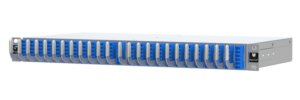
The Aster A-7400 is a Network Packet Broker designed for 10/25/40/100/400 Gb/s multi-rate environments, providing a high-density traffic processing layer for monitoring and security ecosystems.
It is implemented in a 1U chassis with 32 cages, each configurable up to 400 Gb/s, delivering a switching capacity of 12.8 Tbps. The system interfaces network traffic through a single platform and performs aggregation, filtering, and load balancing toward tools operating at different speeds.
Traffic selection is based on inner and outer L2–L5 parameters and UDF filtering, enabling deterministic flow extraction. Selective aggregation (Any-to-Any, Many-to-One, One-to-Many) and IP/L4-based load balancing ensure predictable traffic distribution and prevent tool saturation.
Advanced Packet Manipulation (APM) functions, including packet slicing, header stripping, and timestamping, reduce payload overhead and improve processing efficiency of downstream systems.
The Aster A-7400 also provides an easy-to-use, intuitive web-based graphical interface, along with real-time statistics and SNMP alarms, enabling simplified control of device behavior and input/output traffic.
With multi-rate interface support and fully enabled 32-port architecture, the A-7400 scales from 10 Gb/s to 400 Gb/s within a single platform.
It provides a consistent traffic processing layer that maintains accurate observability and controlled data delivery, ensuring that monitoring and security tools operate efficiently without affecting production traffic.