
As enterprise, service provider and data center networks continue their transition toward 400 Gb/s infrastructures, visibility and security architectures must support increasingly demanding traffic volumes. Delivering unfiltered traffic directly to monitoring and analytics platforms can reduce tool efficiency and limit scalability.
At the same time, organizations continue to deploy inline security technologies (as FW, IPS and WAF) to actively inspect, filter, and manage network traffic. In these environments, maintaining service availability during appliance failures or maintenance operations is essential to preserving operational continuity.
Aster A-7400: intelligent traffic optimization for high-speed visibility
Aster A-7400 is an Advanced Packet Broker designed for modern visibility infrastructures. Positioned between network traffic sources and downstream monitoring or security platforms, it provides a dedicated packet brokering layer that improves the scalability and effectiveness of network observability operations.
Through traffic aggregation, replication, filtering and load balancing, the platform distributes traffic according to the requirements of connected tools. Support for filtering and load balancing based on both outer and inner L2-L4 packet fields enables visibility across encapsulated environments, including L2GRE, L3GRE and VXLAN architectures.
Advanced Packet Manipulation (APM) capabilities such as packet slicing, header stripping, timestamping and tunnel encapsulation/decapsulation further optimize traffic before analysis. These functions reduce unnecessary processing overhead and facilitate integration with virtualized and NFV-based monitoring environments.
With support for up to 32 x 400G interfaces in a single rack unit, the A-7400 enables high-density visibility architectures while maximizing the utilization of connected monitoring and security platforms.

HRB-140: inline resilience without service disruption
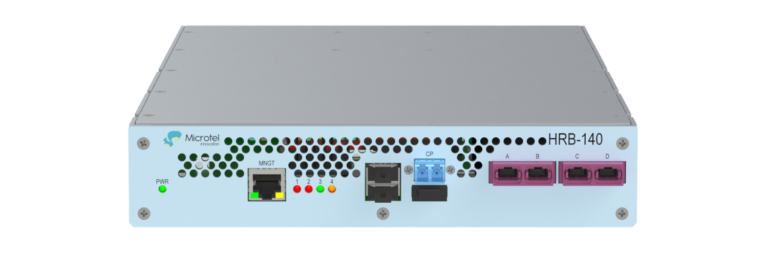
HRB-140 provides a fail-safe connectivity layer for deployments that incorporate inline security appliances. Operating as an inline bypass switch, it continuously monitors appliance availability through bidirectional heartbeat mechanisms without performing traffic inspection itself.
In the event of a fault or power loss, the HRB-140 automatically redirects traffic through the bypass path, preserving link availability and preventing the inline appliance from becoming a single point of failure (SPOF). For planned maintenance activities, the manual bypass function allows connected appliances to be serviced without interrupting production traffic.
Supporting up to two 400/100/40 Gb/s links or eight 25/10 Gb/s links, the HRB-140 enables the deployment of inline security technologies in high-bandwidth environments while maintaining uninterrupted traffic forwarding.
Combined architecture
Aster A-7400 and HRB-140 address different operational requirements and operate on separate layers of the infrastructure.
The A-7400 delivers intelligent traffic distribution for visibility and analytics platforms, while the HRB-140 protects inline inspection deployments against appliance failures and maintenance events.
Together, they separate visibility and security functions from the forwarding path
Architectural benefits
By combining advanced packet brokering with resilient inline bypass capabilities, organizations can build scalable monitoring and security infrastructures capable of supporting modern high-speed networks.
The result is a modular architecture in which visibility and inline inspection functions evolve independently, allowing organizations to accommodate growing traffic volumes while maintaining efficient monitoring, infrastructure resilience and continuous network availability.