Modern data center and carrier infrastructures are rapidly evolving toward 100–400 Gb/s connectivity, driven by spine-leaf architectures and high-volume east-west traffic patterns. While transport layers scale effectively, visibility and security systems increasingly become performance bottlenecks.
This creates a structural gap between high-speed traffic generation and effective traffic inspection, requiring a dedicated architecture for traffic access, conditioning, and inline resilience.

Architectural limitation
Traditional environments separate traffic access, analysis, and inline security enforcement into independent functions. Switch-based mirroring delivers traffic without control, often exceeding tool processing capacity. Inline security appliances introduce dependency on the forwarding path, increasing exposure to failure conditions. At 400 Gb/s scale, the absence of controlled traffic distribution and fail-safe mechanisms limits both observability and service stability.
Tap T-20 and T-30: deterministic traffic access
The Tap T-20 and Tap T-30 operate as passive network access devices, providing lossless and non-intrusive traffic capture at line rate. They extract traffic directly from the link without affecting production flows, ensuring complete data integrity and consistent visibility input for monitoring and analysis systems.
Aster A-7400: traffic conditioning and distribution
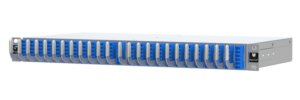
The Aster A-7400 Network Packet Broker operates as an off-path active mediation layer between network sources and toolsets. It performs L2–L5 filtering, aggregation, and load balancing, aligning traffic flows with tool processing capacity. Advanced packet manipulation functions, including slicing, header stripping, timestamping, and tunnel encapsulation or decapsulation, reduce unnecessary traffic volume and support integration with virtualized environments. This defines a traffic conditioning layer that converts raw high-speed traffic into structured and tool-ready data streams.
HRB-140: inline active resilience control
The HRB-140 Optical Bypass Switch operates as an inline active control system, maintaining traffic continuity in the presence of inline security devices. It uses bidirectional heartbeat mechanisms to monitor device health and triggers automatic fail-safe bypass in case of failure or degradation, preserving forwarding across the link. With no added latency during normal operation, it maintains link performance while manual bypass mode allows maintenance without disrupting traffic flow.
Combined architecture
Each Microtel component operates on a distinct layer of the traffic lifecycle, forming a modular visibility and security framework. The Tap T-20 and T-30 provide passive traffic access, the Aster A-7400 performs traffic conditioning and distribution, and the HRB-140 manages inline forwarding continuity. This separation enables independent control of visibility, processing, and forwarding functions, removing dependencies between tool capacity and network availability.
Together, they create a modular framework for scalable high-speed visibility and inline security operations.
Operational impact at 400 Gb/s
The Microtel architecture enables deterministic traffic handling at 400 Gb/s scale, aligning each functional layer with its intended role. Monitoring and security systems receive filtered and distributed traffic streams, while inline forwarding remains resilient to device-level failures. The result is a scalable and predictable architecture for high-speed environments, designed for next-generation visibility and security requirements.